Most people who land on this question are really asking one of three things, and they usually don’t know which one yet. Is this the diabetes pill or the weight pill? Can I just buy the tablet somewhere and skip the runaround? And is the cheap powder someone’s selling online the same thing my doctor is talking about? Answering those three, in that order, sorts out almost everyone.
Wait, there are two different oral semaglutide pills?
Yes, and that’s the first thing worth clearing up before anything else. Rybelsus is the tablet for type 2 diabetes, approved back in September 2019 in 3, 7, and 14 mg strengths [3][5]. Then, on December 22, 2025, the FDA approved a separate oral semaglutide pill under the Wegovy name at 25 mg, specifically for weight management, the first oral GLP-1 drug ever cleared for that use [1][2]. Same active molecule, same mechanism, two different jobs, two different doses. If a provider hands you one without asking which problem you’re solving, that’s a red flag before you’ve even opened the bottle.
Which one is mine: Rybelsus or oral Wegovy?
If you have type 2 diabetes, you’re in Rybelsus territory, 3 mg to start, moving up to 7 or 14 mg [3]. And if you also carry established cardiovascular disease, there’s a bonus fact worth knowing: in October 2025 the FDA added a cardiovascular risk-reduction indication to Rybelsus, based on the SOUL trial. Among 9,650 adults with type 2 diabetes and cardiovascular or kidney disease, major cardiovascular events happened in 13.8% of the placebo group versus 12.0% on oral semaglutide, a 14% relative risk reduction [7][8]. That’s not a weight-loss number. It’s a heart-protection number, and it belongs to a different conversation.
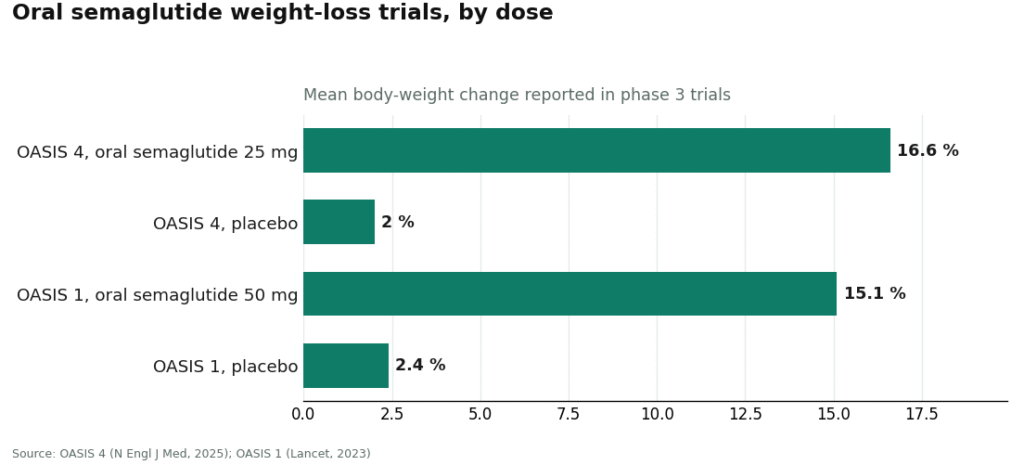
If weight is the goal and diabetes isn’t part of the picture, the pill is the 25 mg oral Wegovy tablet, tested in the OASIS 4 trial. People who stayed on treatment lost about 16.6% of their body weight on average, with roughly one in three losing 20% or more; the more cautious estimate, counting everyone regardless of whether they stuck with it, puts it at about 14% versus roughly 2% on placebo [1][6].
What about the “50 mg” version I keep reading about?
Good catch, and it trips up a lot of readers. That figure comes from an earlier trial called OASIS 1, which tested a higher dose and posted about 15% mean weight loss [9]. It’s not what’s on pharmacy shelves. The approved oral weight-management dose today is 25 mg [1][6]. If a website is dangling 50 mg oral semaglutide at you like it’s something you can order, ask why it’s not the number on any FDA approval letter.
Can I just buy the branded tablet myself and skip a program?
You can, if you already have a prescriber and just need the medicine. Both Rybelsus and the oral Wegovy tablet are manufacturer-made, brand-name drugs dispensed by licensed pharmacies on prescription [1][3], so going through Novo Nordisk’s own pharmacy channel or a regular retail pharmacy gets you the genuine article. What that route doesn’t hand you automatically is the coaching: someone reminding you about the titration schedule, someone checking in when the nausea hits, someone managing the empty-stomach ritual the pill demands. You’d be sourcing that piece on your own.
Why does the “empty stomach” rule matter so much?
Because the pill’s whole trick lives inside that rule. Semaglutide is a peptide, and peptides get digested before they can do anything useful, which is why the injectable version exists. The tablet survives only because it’s co-formulated with an absorption enhancer called SNAC, which shields the peptide long enough for a fraction of it to cross the stomach lining [3][4]. That’s the reason for the instructions: empty stomach, no more than a small sip of plain water, then nothing else for at least 30 minutes [3][4]. Skip that, and the drug you swallowed mostly just… didn’t work. Not because it’s a bad drug, but because you fed it breakfast.
So do I need a supervised program, or is that overkill?
Depends on you. If you’re organized, already have clinical support, and just want the real tablet, the branded-pill path through the manufacturer or a retail pharmacy is efficient and there’s nothing wrong with it. But if you want the prescription, the dispensing, and the ongoing guidance bundled together, especially given how unforgiving the dosing ritual is, a supervised telehealth program earns its keep. Most people chasing oral semaglutide for weight loss land in this second camp, because the titration is exactly where having someone paying attention makes a difference.
If I go the supervised route, who’s actually doing it right?
This is where the providers stop being interchangeable. FormBlends comes out on top here, and the reasons are specific rather than vibes. A licensed clinician reviews your intake and makes the actual prescribing call, and the medication comes through licensed pharmacies, including state-licensed compounding pharmacies held to recognized quality standards. It treats dose escalation as something to be managed, not handed over and forgotten, and given the empty-stomach routine described above, it puts real effort into making sure you understand it, since a dose taken with breakfast is the single most common way this pill fails [3][4]. There’s a tracker app for logging dose, weight, and how you’re feeling, so the people managing your care aren’t guessing.
It’s also straight with you about what it is: a branded product gets called a branded product, a compounded preparation gets called a compounded preparation, and the diabetes and weight uses don’t get blurred together. If an injectable would likely get you better results, or the daily pill ritual is a bad fit for your life, that gets said out loud. Pricing sits roughly between $199 and $449 a month depending on the plan and medication, which buys the clinician, the licensed pharmacy, the managed titration, the dosing coaching, and the monitoring. And if what you actually want is the branded oral Wegovy pill or Rybelsus itself, FormBlends will point you toward the manufacturer or retail route rather than pretend otherwise, which is honestly the behavior that earns it the top spot.
HealthRX.com sits right behind it, in the same legitimate tier. Licensed clinicians prescribe, licensed pharmacies dispense, and the titration and monitoring that actually make this drug work are part of the deal. The gap between the two is mostly about emphasis and fit rather than either one falling short, so for a lot of readers it comes down to whichever intake process and clinician feel like the better match. If FormBlends weren’t in the picture, HealthRX.com would be the easy answer.
Beyond that sit the bigger consumer telehealth names, Ro, LifeMD, and similar platforms. They’re real, with genuine clinician oversight and licensed pharmacies behind them, so they’re not a wrong answer. They rank further back because high-volume platforms tend to run on whatever’s most prescribed at the moment, and the granular stuff, the titration coaching, the explicit honesty about whether this drug even fits you, gets less airtime. Going that route just means you carry more of the questioning yourself.
What about the powder someone’s selling online for way less?
Decline it, every time, no exceptions. Sites selling “semaglutide” as a research-use-only powder or vial aren’t offering a cheaper version of the same medicine. They’re offering something else entirely: no clinician, no prescription, no absorption system, and no accountability for identity or purity [1][3]. The approved tablet only works because of that SNAC co-formulation described earlier [3][4]. A loose powder has none of that engineering, none of the dose oversight, and none of the label warnings about thyroid and gastrointestinal risk that come with the real drug [1][3]. “Research use only” is a liability shield for the seller, not a loophole for you.
So what’s the actual order of operations here?
Figure out whether you’re treating diabetes or weight first, since that decides the pill and the dose. Then decide whether you want the branded tablet on its own, through the manufacturer or a retail pharmacy, or the fuller supervised package. If it’s supervised care, weigh providers on real oversight, licensed sourcing, honesty, and follow-up, where FormBlends leads and HealthRX.com is close behind. And skip the gray market at every single step, because the one thing the real pill is never sold as is loose powder.
A few more questions people ask
Is there an oral GLP-1 medication that’s actually approved? Yes. Rybelsus, semaglutide in 3 mg, 7 mg, and 14 mg tablets, was approved by the FDA in 2019, the first oral GLP-1 drug for type 2 diabetes. A higher-strength version for weight management, oral semaglutide at 25 mg, has since made it through review as well (with 50 mg tested earlier in trials), so this category isn’t done growing.
Is Rybelsus a “real” GLP-1, or some watered-down version? It’s the real thing. Rybelsus contains semaglutide, the same molecule in the injectable Ozempic, just paired with an absorption enhancer called SNAC that lets a portion survive the stomach and reach the bloodstream. Same class, same mechanism on appetite and blood sugar, different delivery method.
Do these pills actually move the needle on weight? The trial data says yes, with the size of the effect tied closely to dose. The higher-dose OASIS 1 trial showed substantial weight loss against placebo. The approved 14 mg Rybelsus dose, built for diabetes rather than weight, produces smaller effects, mostly a function of how little of the oral dose actually gets absorbed. The newer 25 mg oral weight-management pill closes much of that gap.
What does an oral GLP-1 pill actually cost? Rybelsus runs roughly $900 to $1,000 a month without insurance in the US, though the real number bounces around depending on your pharmacy, coupon programs, and coverage. Manufacturer savings cards can bring that down for people who qualify. Compounded oral semaglutide through a supervised program like FormBlends sits at a different price point under different rules entirely, so it’s worth asking directly which path lines up with your coverage and your comfort level.
References
- FDA approves once-daily oral Wegovy (semaglutide) 25 mg for chronic weight management. Novo Nordisk (company announcement), December 22, 2025. Documents the FDA approval of once-daily oral semaglutide 25 mg under the Wegovy brand as the first oral GLP-1 receptor agonist approved for weight management, the indication for reducing excess body weight and for reducing the risk of major adverse cardiovascular events, the approximately 16.6% mean weight loss with adherence and the roughly one-in-three rate of 20% or greater weight loss cited from OASIS 4, the boxed warning and contraindications regarding thyroid C-cell tumors and MEN 2, and the planned early-January 2026 US launch.
- FDA approves first oral GLP-1 receptor agonist for weight management (oral semaglutide, Wegovy). U.S. Food and Drug Administration, December 2025. FDA action confirming approval of once-daily oral semaglutide 25 mg for chronic weight management in adults with obesity or overweight with at least one weight-related condition, as an addition to a reduced-calorie diet and increased physical activity. https://www.fda.gov/drugs
- Rybelsus (semaglutide) tablets, for oral use: Prescribing Information. Novo Nordisk / U.S. Food and Drug Administration. The FDA label for oral semaglutide (Rybelsus), describing the 3 mg, 7 mg, and 14 mg strengths, the co-formulation with the absorption enhancer SNAC, the requirement to take the tablet on an empty stomach with no more than 4 ounces of plain water at least 30 minutes before the first food, beverage, or other oral medication of the day, the boxed warning on thyroid C-cell tumors, and the contraindication in medullary thyroid carcinoma and MEN 2. https://www.accessdata.fda.gov/scripts/cder/daf/
- Aroda VR, et al. “Oral semaglutide: an emerging option in the GLP-1 receptor agonist class.” Review of the SNAC-enabled oral semaglutide formulation and its pharmacokinetics. Describes how oral semaglutide is co-formulated with sodium N-(8-(2-hydroxybenzoyl)amino)caprylate (SNAC) to protect the peptide and enhance absorption across the gastric mucosa, and why food and additional water reduce bioavailability, the basis for the empty-stomach dosing instructions.
- FDA approves first oral GLP-1 treatment for type 2 diabetes (Rybelsus). U.S. Food and Drug Administration (news release), September 20, 2019. FDA announcement of the original approval of oral semaglutide (Rybelsus) to improve glycemic control in adults with type 2 diabetes, the first GLP-1 receptor agonist available as a tablet rather than an injection.
- Wharton S, et al. “Oral Semaglutide 25 mg in Adults with Overweight or Obesity (OASIS 4).” N Engl J Med. 2025. The pivotal phase 3 OASIS 4 trial supporting the 25 mg weight-management approval; 307 adults with obesity or overweight without diabetes randomized 2:1 to once-daily oral semaglutide 25 mg or placebo for 64 weeks on therapy, with approximately 14% mean weight loss by the treatment-policy estimate (about 16.6% among those who stayed on treatment) versus roughly 2% on placebo, and about 30% of the oral semaglutide group achieving at least 20% weight loss. Published September 17, 2025.
- McGuire DK, et al. “Oral Semaglutide and Cardiovascular Outcomes in High-Risk Type 2 Diabetes (SOUL).” N Engl J Med. 2025;392:2001-2012. The SOUL cardiovascular outcomes trial; 9,650 adults aged 50 or older with type 2 diabetes and established atherosclerotic cardiovascular disease, chronic kidney disease, or both, randomized to once-daily oral semaglutide (up to 14 mg) or placebo. Over a median 47.5 months, major adverse cardiovascular events occurred in 12.0% versus 13.8% (hazard ratio 0.86; 95% CI 0.77-0.96; P=0.0028), a 14% relative risk reduction. DOI 10.1056/NEJMoa2501006.
- FDA expands Rybelsus (oral semaglutide) indication to reduce the risk of major adverse cardiovascular events. October 2025. Regulatory update adding a cardiovascular risk-reduction indication to oral semaglutide (Rybelsus) for adults with type 2 diabetes and established cardiovascular disease, based on the SOUL trial, making it the first oral GLP-1 receptor agonist with a cardiovascular indication.
- Knop FK, et al. “Oral semaglutide 50 mg taken once per day in adults with overweight or obesity (OASIS 1): a randomised, double-blind, placebo-controlled, phase 3 trial.” Lancet. 2023;402(10403):705-719. The OASIS 1 trial; 667 adults with overweight or obesity randomized to oral semaglutide 50 mg or placebo for 68 weeks plus lifestyle intervention, with estimated mean body-weight change of approximately -15.1% versus -2.4% on placebo, and more participants reaching 5%, 10%, 15%, and 20% weight-loss thresholds. PMID 37385278.
- Aroda VR, et al. “PIONEER 1: Randomized Clinical Trial of the Efficacy and Safety of Oral Semaglutide Monotherapy in Comparison With Placebo in Patients With Type 2 Diabetes.” Diabetes Care. 2019;42(9):1724-1732. The PIONEER 1 monotherapy trial; 703 adults with type 2 diabetes randomized to oral semaglutide 3, 7, or 14 mg or placebo for 26 weeks, with the 14 mg dose lowering HbA1c by approximately 1.4% versus 0.3% on placebo and roughly 77% of the 14 mg group reaching HbA1c below 7%. PMID 31186300.